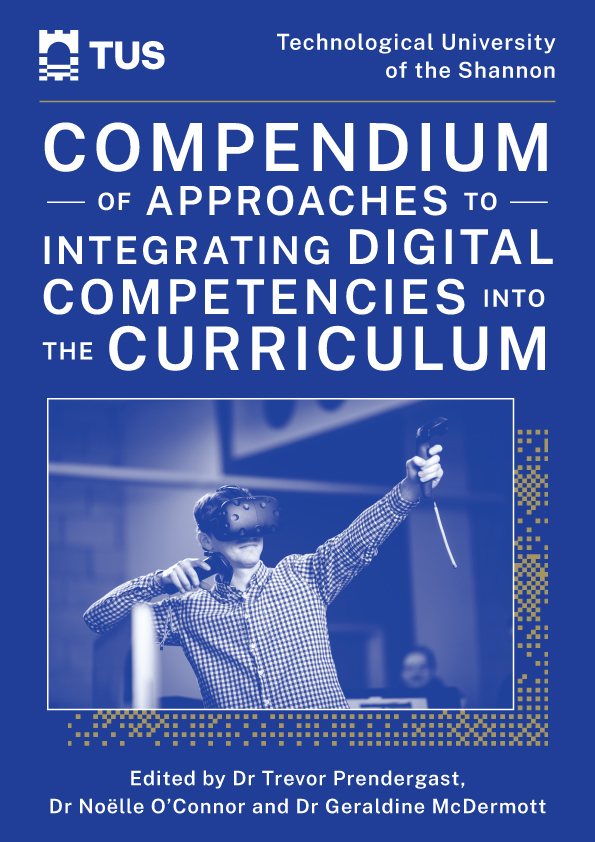
The Centre for Pedagogical Innovation and Development (CPID) is pleased to announce the launch of the Compendium of Approaches to Integrating Digital Competencies into the Curriculum, on Wednesday, 7 October, from 11:00 am to 12:45 pm.
Location: Room B09, Athlone Campus and Online
The compendium will be formally launched by Professor Vincent Cunnane, President of TUS. We are also pleased to welcomeMs Sheila MacNeill, a celebrated higher education consultant, on digital transformation and teaching innovation, who will deliver the keynote address. In addition, Mr Colin Lowry, Senior Manager, Teaching and Learning, Enhancement and Digital Innovation at the Higher Education Authority, will also address the launch, which will include examples of some of the TUS case studies published in the compendium. Ms Frances O’Connell, Vice President Student Education and Experience, will present closing remarks. And finally, the event will be closed by Dr Trevor Prendergast, Head of Department of Accounting and Business Computing.
The Technological University of the Shannon (TUS) Compendium of Approaches to Integrating Digital Competencies into the Curriculum exemplifies the University’s commitment to embedding digital capability development across teaching, learning, and assessment. It showcases how TUS integrates research-informed and practice-based approaches into programme design, pedagogy, and assessment, equipping students with the skills and confidence required to thrive in a digitally driven society.
Specifically, the compendium highlights innovative approaches aligned with national and international digital education priorities, focusing on learning environment transformation, educator capacity-building, digital inclusion, student engagement, and future-focused employability. It demonstrates how digital pedagogies and associated technologies are being used to enhance learning experiences, promote critical digital competences, and support active, collaborative, and flexible learning.
This compendium serves as a practical guide for educators, students, and stakeholders, presenting best practices, case studies, and insights into how digital capabilities can be meaningfully and sustainably embedded within higher education. By sharing these approaches, TUS aims to inspire and support a university-wide culture of digital excellence, ensuring that all students are empowered to participate with confidence, in an ethical manner and with creativity in an increasingly complex digital world.
Following the launch The Centre for Pedagogical Innovation and Development (CPID) is delighted to host a workshop facilitated by Sheila MacNeill.
Workshop Details
The workshop will explore ways to formally integrate digital capabilities into programme documentation and in turn embed digital capabilities in teaching and learning practice. We will discuss where, how, and if digital capabilities are currently integrated as part of core standard outcomes and specific programme level learning objectives, and how they could be used more consistently.
Date: Wednesday, October 7th
Time: 1:30 pm – 3:00 pm
Location: Room B54, Athlone Campus
Title: Integrating digital competencies and programme level learning outcomes
This workshop is open for all TUS staff to register; no prior experience with digital competencies is required.
Transforming how we learn, teach, and train for the future
Extended Reality (XR) technologies — including augmented reality (AR), virtual reality (VR), and mixed reality — are transforming how we teach, learn, and prepare for an immersive future. EduXR26 brings together educators, researchers, industry partners, and learners to share experiences, strengthen networks, and forge new connections within our growing XR community.
This one-day, in-person symposium took place on May 12th at the Technological University of the Shannon (TUS), Athlone campus.
The video below shares some highlights from this year’s event.
In 2003 she founded and co-directed (until 2016) “makebelieve”, a consulting company designing digital experiences for museums. Previously, she established (in 1998) and directed (until 2003) the Virtual Reality Department at the Foundation of the Hellenic World, where she was responsible for setting up the immersive projection-based VR exhibits and managing the research, design, and development of the VR programs and related visitor experiences. For most of the nineties (1993-1997), during her extensive work with the CAVE® at the Electronic Visualization Laboratory in Chicago, she focused on the design, application, and evaluation of virtual and digital media environments for education and the representation of cultural information.
Maria has published over 90 refereed journal and conference papers, mostly in the areas of virtual reality & education and digital heritage. Her recent research projects include EMOTIVE (11/2016-11/2019), the CHESS Project (02/2011-04/2014), in which she led the User-Centered Design & Scenarios work, and the MAGELLAN Project (2013 – 2017), in which she worked on usability and user experience evaluation. She is an active member of a number of professional organizations, such as ACM as a Senior Member and as Vice Chair of the Greek ACM SIGCHI Professional Chapter and the Greek ACM-W Chapter), IEEE, and ICOM. She is the recipient of the 2013 Tartessos Award for her contribution in Digital Heritage and Virtual Archaeology.
Submission Information
Student Competition
Best Higher Education Undergraduate XR project
First Prize €300
Second Prize €200
This competition encourages final-year students to submit their end-of-year XR (Augmented Reality, Virtual Reality, Mixed Reality) projects that align with one or more of the following three themes.
Best Higher Education Postgraduate XR project
First Prize €300
Second Prize €200
Masters and PhD students are invited to enter this category based on their research (ongoing or completed) in an XR context, aligned with one or more of the following three themes.
Best Further Education/Training XR project
First Prize €300
Second Prize €200
Students from the Further Education and Training sector are invited to submit their projects, aligned with one or more of the themes below.
Deadline: May 1st, 2026
Submission: Closed
Student submissions should align broadly with one of the following themes:
Impact on Society
Focusing on how individuals and communities learn, work, connect, and interact. It includes education and healthcare and takes note of the Sustainable Development Goals.
Aesthetic production
Focusing on the design that shapes the emotional experience of the user. The aesthetic quality directly impacts how immersive a AR/VR/MR experience feels and plays a vital role in achieving engagement and a sense of presence.
Technical Innovation
Focusing on technical innovativeness in creating the project, and includes the functionality, performance, and user experience of immersive systems.
The judging panel will include academic and industry experts, and the prizes will be presented to the winners during the symposium.
To download the Poster Template please click on the link below.
Academic Integrity Week is an important initiative aimed at promoting ethical learning practices and fostering a culture of honesty and respect within educational institutions. The week focused on raising awareness about academic integrity, addressing issues like plagiarism and cheating, and providing resources to help students and staff uphold ethical standards in their academic work. Please see below for the student and staff programmes.:
Click on the link below to download the student progamme:
The Centre for Pedagogical Innovation and Development (CPID) is pleased to announce the launch of the two most recent volumes of our compendia series.
Compendium of Embedding Education for Sustainable Development in Teaching, Learning, and Assessment
The Technological University of the Shannon (TUS) Compendium of Embedding Education for Sustainable Development in Teaching, Learning and Assessment exemplifies the university’s commitment to embedding Education for Sustainable Development (ESD) across teaching and learning. It showcases how TUS integrates research-informed practices into programme design, teaching, and assessment, equipping students to tackle global sustainability challenges. Specifically, the compendium highlights innovative approaches aligned with the ESD for 2030 Priority Action Areas, focusing on policy advancement, learning environment transformation, educator capacity building, youth empowerment, and local-level action. This compendium serves as a practical guide for educators, students, and stakeholders, presenting best practices, case studies, and insights into how ESD can be meaningfully embedded within higher education. By sharing these approaches, TUS aims to inspire and support a university-wide culture of sustainability, ensuring that all students are equipped to contribute to a more sustainable world.
Compendium of Approaches to Internationalisation of the Home Curriculum
By embedding internationalisation in the home curriculum, TUS offers all students access to global and intercultural perspectives regardless of whether they can access education opportunities abroad. In doing so, it also promotes and supports sustainable internationalisation. Beyond reduced carbon emissions, internationalisation at home also contributes to the agenda to develop a sustainable university community by helping us to produce graduates who represent responsible global citizens committed to a sustainable future. The Compendium of Approaches to Internationalisation of the Home Curriculum captures examples of internationalisation of the home curriculum in our university. It includes cases of internationalised modules; teaching and assessment practices that promote inclusive learning; collaborative learning and teaching projects involving international partners; and co-curricular intercultural competence initiatives. The sample of approaches collected here represents a snapshot of just some of the efforts made by TUS to internationalise our home curriculum. They demonstrate how, by embracing the ever-increasing cultural diversity within our university and developing curiosity about and awareness of international and intercultural perspectives, we encourage global citizenship, foster empathy, elevate the learning experiences of our students and enhance campus life for everyone in our university community.
“The word “meitheal” is part of ancient Irish tradition. It describes a workgroup or team that gathers and works collaboratively to support each other through a shared purpose. Culturally significant, the meitheal represents shaping and building communities.”:
Professor Phillip (Phill) Dawson is Co-Director of the Centre for Research in Assessment and Digital Learning (CRADLE) at Deakin University. His work focuses on improving assessment while addressing integrity challenges and emerging technologies. His latest book, Defending Assessment Security in a Digital World (Routledge, 2021), examines academic integrity in a digital age. In 2024, he co-edited the Assessment & Evaluation in Higher Education special issue Challenging Cheating and published the provocative article Validity Matters More Than Cheating. His broader research spans assessment design and feedback.
Seminar Details
Title: Where is the line? Re-thinking assessment design for a time of artificial intelligence
Artificial intelligence can now generate outputs that meet the requirements of high-stakes assessments in fields like computing, health professions, business and engineering. This has sparked concerns about students using AI inappropriately to complete tasks, misrepresenting their abilities. It also raises deeper questions about the sustainability and authenticity of current assessment practices. Students and staff are justified in asking: Where is the line between acceptable and unacceptable uses of AI in assessment?
This presentation examined how assessment must evolve in response to AI. It draws on the presenter’s work as one of the leaders of Assessment Reform for a Time of Artificial Intelligence, a major Australian project funded by the national higher education regulator. As AI becomes an ever-present part of professional and academic life, how do we design assessments that both uphold integrity and prepare students for this new reality?
Belonging in Higher Education
Dr Jonathan Vincent is a lecturer in Educational Research at Lancaster University. He is Programme Director for the MA in Education and Social Justice and Director for Internationalisation. His research largely focuses on the nature and experience of life course transitions for neurodivergent/disabled learners, with particular emphases on inclusive education and employment. He is also interested in how belonging in higher education is theorised and experienced by disabled staff and students. Jonathan recently provided oral evidence to the House of Lords Autism Act 2009 Committee and has also provided expert evidence to government ministries and departments in Malta, Indonesia, and Australia. He is principal investigator on a range of funded projects in the UK and internationally, including some in Indonesia, Malaysia, and Uganda. Jonathan has published widely in high impact journals across various research fields including higher education, psychology, disability studies, legal education, and medical education and is Editor-in-Chief for the SAGE journal, Research in Education.
Session Details
Main Session
Title: ‘ In between belonging in higher education: what, who, where, and when for institutions.’
This talk centred on the concept of belonging in higher education, identifying it as an increasingly prevalent and powerful concept, but one that is largely contestable. Through opening up what we mean by belonging – and its in between spaces – we are in a better position to consider when it is most vital; where it might operate within institutions; and, ultimately, for whom it is most important. Drawing on both theoretical and empirical work, this talk will stimulate discussions for colleagues to consider what belonging at The Technological University of the Shannon means for staff and students and catalyse planning for the future.
Dis-Ability & Allies Staff Network Session
Title: ‘I’m just the nuisance crip’: flows of un/belonging for disabled staff and PGR students.’
This talk centred on the concept of belonging in higher education, identifying it as an increasingly prevalent and powerful concept, but one that is largely contestable. By drawing on empirical qualitative data offered by disabled staff and disabled PhD students from across the UK, it aims to generate vital reflections and dialogue about the nature of belonging in universities, including its affective, relational, temporal-spatial, and political dimensions. Based on these, we will consider the conceptual worth and practical potential of un/belonging for disabled members of higher education institutions, including the Technological University of the Shannon
Lancaster PhD information sessions for staff
Dr Vincent also hosted two PhD information sessions for staff who wish to avail of the opportunity to complete one of four PhD programmes at Lancaster University.
The Centre for Pedagogical Innovation and Development (CPID) has developed a partnership with the Department of Educational Research at Lancaster University to provide opportunities for TUS staff to complete one of their PhD programmes. The partnership aims to build closer links between Lancaster University and TUS in both teaching and research. It will also provide the potential for developing further collaboration between the Department of Educational Research at Lancaster University, CPID, the TUS Graduate School, and the TUS Research Office. This will include capacity building and engagement on collaborative research projects. It will also provide further opportunities for staff mobility and visiting scholars.
The four doctoral programme currently on offer are
Doctoral Programme in Education and Social Justice.
Doctoral Programme in Higher Education Research and Evaluation.
Doctoral Programme in Educational Research (DPER).
Doctoral Programme in E-Research and Technology Enhanced Learning
Peer Assisted Student Support (PASS)
The European Centre for SI-PASS (Lund University), partnering with UK consultants, held an in-person comprehensive SI-PASS Supervisor Training course from the 10th to 12th June 2025 in Athlone.:
The training focused on:
Procedures for selecting subjects or modules to implement SI-PASS
Roles of supervisor, academic staff, administrative staff, and leaders
Selecting, training and supporting student leaders
Effective learning strategies and session activities
Evaluation and funding
What attending participants have said
“A great deal gained from the sessions, including a wide range of activities and resources, a great deal of perspective from colleagues, and a renewed confidence in being able to champion a scheme. A fantastic week.”
“Thank you so much – It was probably some of the best training I’ve ever had. Really high quality and lovely atmosphere. It was also just really useful in terms of developing other teaching type skills (beyond PASS) – so I learnt absolutely loads.”
Further Information
If you would like more information on PASS here in TUS, please go to PASS – TUS
Shaping the Future of Immersive Technology in Education and Training Symposium
Shaping the Future of Immersive Technology in Education and Training Symposium:
This one-day, in-person symposium brings together educators, researchers, industry partners, and learners to explore the current and future potential of extended reality (XR) applications within an education and training context.
Immersive experiences in augmented and virtual reality are becoming more accessible to a wider audience, and this symposium invites participants to join the conversation on May 14th at the Technological University of the Shannon (TUS), Athlone Campus.
Designed to bring together the community of XR users, this event will provide participants with a platform to share experiences, strengthen existing networks, and create new partnerships to grow the XR education and training sector in Ireland.
Contributions are invited from educators, researchers, and industry partners on how immersive experiences are changing the face of simulation-based education and training, and providing learners with experiential learning opportunities.
We welcome all submissions on the topic of immersive technologies in education and training that address, but are not limited to, the following subthemes:
The design and/or implementation of tools for immersive learning /experiences
Case studies and/or disciplinary approaches to embedding immersive experiences
Theoretical perspectives on immersive experiences
Multimodal literacies and immersive learning
Cross-cultural and inclusive approaches to immersive education
The application of XR technology in a training context in industry
Professor Chris Headleand, Head of Games Design and Technology Department, University of Staffordshire, UK
n
Professor Christopher Headleand is a Computing and Video Games academic with over 20 years’ experience in a variety of teaching and learning roles. He is internationally recognised as an expert in student engagement and was awarded a prestigious National Teaching Fellowship in 2021. His research focuses on Virtual Reality, Visualisation, and Serious Games and we are honored to have him share his insights with us.
Keynote Title: Beyond the Headset: A Future for Immersive Technologies in Education.
ReSHAPE is co-funded by the Government of Ireland and the European Union through the EU Just Transition Fund Programme 2021-2027