
This course is accredited by the Chartered Institute of Building and Engineers Ireland.

Course Search
Courses
Admissions & Support
Course Search
Our Services
Our Community
Course Search
Governance
Professional Services

CAO Points: 327
Location: Moylish, Limerick City
years: 4
Fact – TUS graduates are the most employable in Ireland.
We are Ireland’s top university for graduate employment for 3 years in a row!The programme is designed in partnership with industry and uniquely merges civil engineering with management skills. It provides graduates with the knowledge, skills and techniques used in civil engineering management. The programme is a four year sandwich: two years full-time study, one year of practical work experience (or equivalent) and a final year of full-time study.
Graduates will be able to manage the construction and maintenance of infrastructural developments. Such work would include bridges, marine works, tunnels, motorways, railways, airfields and environmental projects including water and waste water systems, pipelines, waste management and residential, commercial and industrial buildings.
This course is accredited by the Chartered Institute of Building and Engineers Ireland.
Sajjad Sajjadi
Email: Sajjad.Sajjadi@tus.ie
A minimum of 2 H5 & 4 O6/H7 grades in six Leaving Certificate subjects, including Mathematics and English or Irish.
Candidates applying as mature applicants may be required to attend an interview and may be requested to take an aptitude test to prove their suitability for a place on this programme.
International applicants should apply directly to the International Office at TUS, allowing plenty of time for completing the visa process. Applications for September start should be made by 1st June at the latest to ensure visas are processed in time. You should familiarise yourself with visa processing times for your country of origin to ensure you make a timely application. Find out more here.
Construction Technology
Credits: 10
This module aims to explain the principals of technology, practice and materials involved in domestic construction.
Land Surveying
Credits: 10
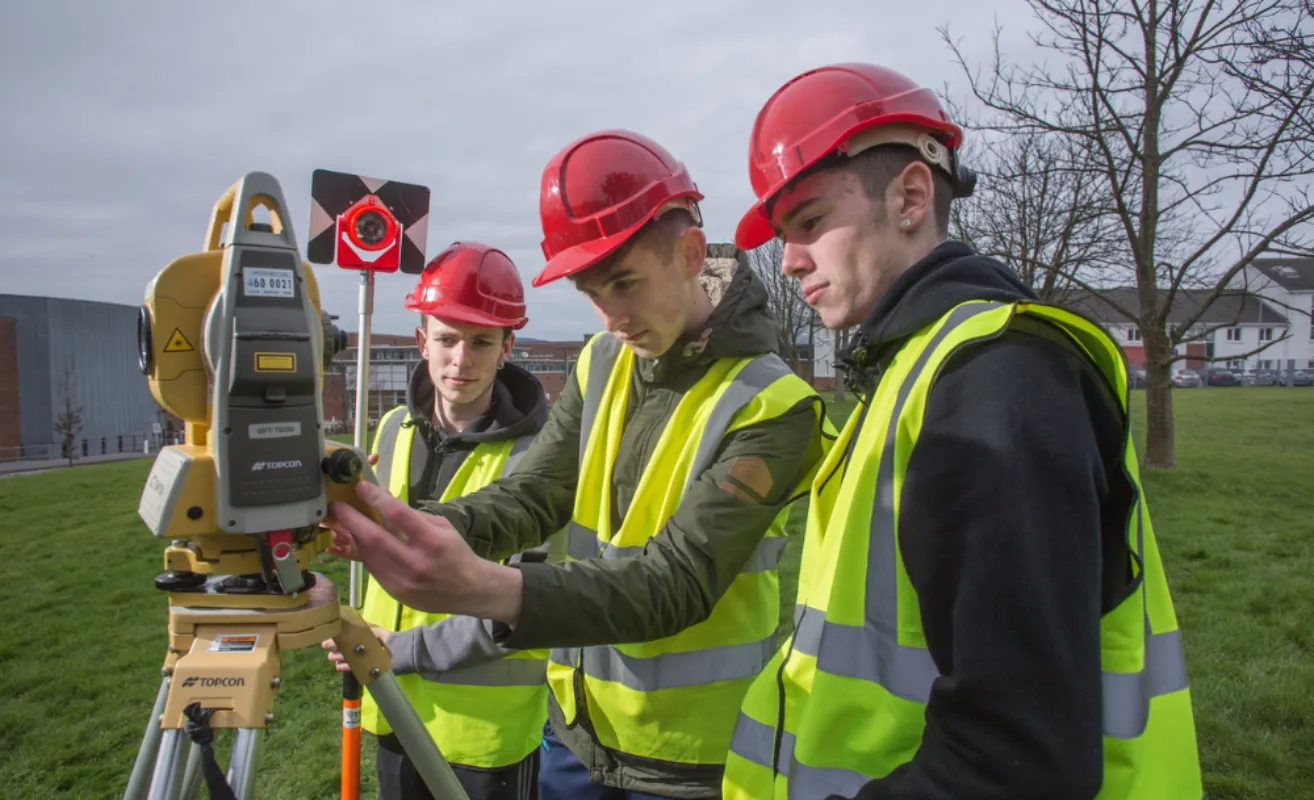
Master the essentials of land surveying, from using GPS and lasers to measure terrain to setting out complex building sites and road curves. You will gain hands-on experience with coordinate systems, vertical control, and earthworks while mastering industry-standard tools like AutoCAD Civil 3D, GIS, and Excel.
Sustainable Building Systems
Credits: 10
The aim of this module is to enable learners to understand the role of Building Services, Environmental Systems, and Structural Systems, in the functioning of modern buildings.
Economics For Construction And Property Specialists
Credits: 10
This module sets out to develop an understanding of the concepts and principles of economic theory in the context of the construction / property environment.
Engineering Mathematics
Credits: 5
Develop the core mathematical skills needed for technical success, covering everything from advanced trigonometry and 3D volumes to vectors and statistics. You’ll also be introduced to the power of differentiation and integration to model and solve professional challenges.
Research And Technical Skills
Credits: 5
To develop the students knowledge and ability in Research and essential Hard & Soft Technical Skills. This will enable the student to communicate effectively and professionally using technology as an aid. It will also give the student a competent knowledge of IT relevant to their degree programme and used throughout the Industry.
Built Environment Law
Credits: 5
The aim of the module if to enable learners to develop a basic understanding of the Irish legal system as it relates to the built environment and construction industry.
Construction Practice And Materials
Credits: 5
The construction industry uses various materials for construction therefore the student needs to understand the properties of these materials, the use of these materials in construction and the specifications for these materials. Therefore this module provides the student with a detailed and comprehensive knowledge of construction materials including Concrete, Soils, Aggregates and Road Pavement materials.
Integrated Project & Placement Preparation (Year long)
Credits: 5
This module integrates the second year modules into a major project that simulates a real life construction development to prepare student for placement year.
Surveying
Credits: 5
The module aim is to provide learners to understand the fundamentals roles of engineering surveying at the concept and design stage for the production of maps or plans.
Construction Management & I.T. Y2
Credits: 5
To provide students with the basic concepts, knowledge and techniques of management used within the construction industry.
Civil Engineering Law: Pre-Construction
Credits: 5
The aim of this module is to introduce learners to legal aspects of the procurement process of the project life cycle of a civil engineering project up until contract acceptance. This will cover project initiation, procurement and tendering over the course of the module.
Construction Technology
Credits: 10
This module establishes the construction principles and practices fundamental to the production of successful Industrial and Commercial construction projects.
Structures For Civil Engineering
Credits: 5
An introductory module on civil engineering structures – what they are, examples, behaviour and design of simple elements of structures; overview of sustainability considerations. The structures topic is supported by practical learning in the engineering graphics and CAD syllabus in this module.
Civil Engineering Law: Contract Performance
Credits: 5
The aim of this module is to introduce learners to legal aspects of the contract performance stage of the project life cycle of a civil engineering project through till handover, review and closeout. This will cover the contractual binding, project administration and risk management of the project.
Building Information Modelling & Digital Technology In Construction
Credits: 5
This module will introduce the students to the latest relevant technology tools being used in the construction industry. The overall aim of the course is to provide students with the basic concepts, knowledge and techniques of the latest construction technology tools being used within the construction / civil engineering industry. The students will gain this knowledge in a hands-on course with delivery through a variety of demonstrations and practical exercises.
Fluid Mechanics, Water And Wastewater Systems
Credits: 5
To develop concepts and formulae relating to fluid mechanics and to apply these concepts in the design of basic water and sewer networks. To introduce water treatment processes, to outline the role of regulators in the industry and to recall relevant water quality parameters set out in legislation. To introduce wastewater treatment processes, to explain the parameters by which wastewater is measured and to discuss the general considerations involved in maintaining a functioning treatment plant.
Civil Engineering Practice
Credits: 5
The construction industry uses various materials for construction and all of the materials need to be tested in order to ensure compliance with the relevant specification. This module requires the student to undertake practical testing of materials such as soils, concrete and aggregates in the material laboratories provided. The practical work provides the student an understanding of materials used in civil engineering construction and the procedures used for testing such materials. This module also provides the student with an understanding of the procedures involved in the construction of various structures such as tunnels, bridges, marine structures, retaining walls and the plant and equipment required to construct such structures.
Surveying For Construction & Civil Engineering Managers
Credits: 5
Master the surveying skills required to plan, design, and set out engineering works from initial site development to post-construction monitoring. You will learn to execute topographical surveys and work in teams to deliver projects on time and to exact industry specifications.
Active Learning Diary and Professional Competencies
Credits: 25
The aim of this module is to develop the student’s professional skills and competencies through experiential learning while on placement within industry.
Capstone Project
Credits: 15
The Capstone Project aims to enhance the student’s inter-personal skills, increase their level of awareness of the construction process, develop their knowledge base and strengthen their professional identity. Undertaking a Capstone Project allows the student to analyse the important issues in a construction project.
Management Practice
Credits: 10
The aim of this module is to develop the learner’s knowledge and critical understanding of the theoretical principles and management practices as applied to the built environment.
Dissertation Development
Credits: 10
This module commences the development of the dissertation by the student. The student prepares a “Research Proposal” which is the initial stage of the dissertation. The “Research Proposal” defines the topic chosen for the dissertation and in particular the rationale for researching this topic is developed. The topic selected for the dissertation must be directly relevant to the programme being undertaken by the student. Pursuant to the “Research Proposal” the student prepares a “Literature Review” on the topic chosen for the dissertation. The student shall apply appropriate research methods in the production of a literature review. The “Research Proposal” and “Literature Review” constitute the initial steps towards the research and analysis that is required to produce a dissertation in Year 4 of the programme.
Dissertation (Year long)
Credits: 15
To provide an opportunity for the student to produce a document based on independent study, of which the topic selected will provide an exhaustive, critical, and in-depth analytical study of a specific area of interest. The topic selected must be directly relevant to the course of study being undertaken by the student.
Civil Engineering Site Management
Credits: 5
To develop the students knowledge of civil engineering, its practice, the changing environment and the associated issues and risks for the civil engineering manager.
Human Resource Management In Civil Engineering
Credits: 5
This module aims to provide students with the concepts, knowledge and techniques with regards to human resource management in the civil engineering industry. These knowledge and skills will enable the students to perform as managers in the civil engineering industry. The module covers various aspects of management theory, human resource management, etc which facilitates the students to manage people and understand the friction between individual needs and organisational needs. This module strives to the give the student an insight into people management by analysing the various issues concerning human resource management and industrial relations.
Building Information Modelling & Virtual Design And Construction
Credits: 5
Building Information Modelling and Virtual Design & Construction brings together two key technologies and approaches prevalent in modern construction project delivery. Building Information Modelling is firmly embedded in most Tier 1 construction companies in Ireland and abroad. Much of the focus of BIM has been on the Design and Documentation of building design and specification through the implementation of digital technologies. Virtual Design & Construction takes this concept further by utilising the digital model to better understand the built asset design and leverage this information during the construction process. This approach leads to better outcomes on the construction site and leads to improved value for clients and contractors.
Structural Engineering For Civil Engineering Managers
Credits: 5
This module is concerned with structural engineering topics, both technical and related to the design function and process on civil engineering projects. The module is slanted towards structural engineering topics of relevance to civil engineering managers.
Advanced Civil Eng. Surveying (Elective)
Credits: 5
This module develops further the principles of site surveying and setting out.
Urban Economics And Housing Policy (Elective)
Credits: 5
The aim of this module is to develop in students an understanding of the implications for the Property and Construction Industry of the overall impact of public policy priorities in Ireland and the UK, particularly as expressed in the evolution of Housing Policy, in the modern era. Referencing throughout, the relevant spatial and urban development theories which underpin these policy applications.
Sustainable Environmental Engineering (Elective)
Credits: 5
This module address the environmental engineering topics in civil engineering and buildings including rainfall estimation, pipe network design, hydraulics, waste management and carbon emissions from buildings. Sustainability is applied to the management and design involved in each topic.
Civil Engineering Practice Y4
Credits: 5
To develop the students knowledge of civil engineering, its practice, the changing environment and the associated issues and risks for the civil engineering manager.
Civil Engineering Management
Credits: 5
This module introduces the students to various disciplines that are encompassed by the role of the Civil Engineering Manager. The students will learn about Heatlh & Safety in a civil engineering context and the procedures involved in estimation, measurement, procurement and tendering with regard to civil engineering projects. The students will be enabled to develop an understanding of the role of the Civil Engineering Manager and the interaction of the Civil Engineering Manager with the various stakeholders involved in a civil engineering project. This module will facilitate the students to apply managerial skills and principles to the work environment and role of the Civil Engineering Manager.
Project Management & Integrated Project Delivery
Credits: 5
The ability to manage projects is a key skill for construction professionals. Project Management, as an academic domain, has evolved from a process-driven approach to a value-driven approach. Construction has also evolved to include deeper integration of digital technologies into the delivery process. This module provides learners with the traditional skills of the project manager, and the digital skills necessary for Integrated Project Delivery. This is underpinned by a clear focus on generating value for clients, contractors, and the wider community.
Sustainable Construction (Elective)
Credits: 5
To evaluate a wide range of topics under sustainable construction which are driving the environmental agenda.
Financial Management And Tax Aspects Of Property Transactions (Elective)
Credits: 5
To develop knowledge and understanding of the way organisations finance their operations, plan and control cash flows, optimise their use of working capital and allocate resources to capital expenditure projects. To develop an understanding of Irish Tax system and have the ability to prepare computations of tax liability for both individuals and businesses for the purposes of Income tax, corporation tax, capital gains tax, capital acquisition tax, stamp duties and value added tax.
Further Structural Engineering For Civil Engineering Managers (Elective)
Credits: 5
This module is concerned with structural engineering topics, both technical and related to the design function and process on civil engineering projects. The module is slanted towards structural engineering topics of relevance to civil engineering managers.
Employment opportunities include positions as Site Engineer, Civil Project Management, Civil Engineering Contractor, Consulting Civil Engineer. Our graduates are employed by Local Authorities, Civil Engineering Contractors and Consulting Engineers.
Graduates of this course can also progress to postgraduate courses at TUS and other 3rd level universities and colleges.
Midwest Campuses CAO Newsletter
Click here