
Course Search

Course Search

Course Search

Robotics and Automation Engineering – BEng

  • CAO Points: 215

  • Location: Moylish, Limerick City

  • years: 3


Course Overview

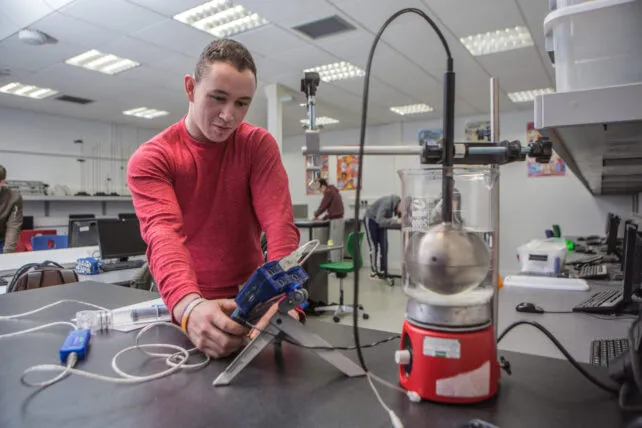
The Bachelor of Engineering in Robotics and Automation Engineering is a multidisciplinary three-year engineering programme. The main areas of engineering covered on the programme include: Electrical, Electronics, Advanced PLCs and SCADA, Programming, Process Control and Instrumentation, CAD, Industrial Networks, Motion Control and Robotics Systems and Work Placement.

Manufacturing in Ireland is highly automated and there is a move towards Industry 4.0, the smart factory, which is advancing manufacturing operations in Ireland. Modern automated production lines will involve data exchange, cyber-physical systems, the Internet of Things and cloud computing. It is this advancement that requires a programme such as Robotics and Automation Engineering to develop and ensure that technicians and engineers leave the programme with skills and competences that allow them to design, commission, debug and repair intelligent machines, including industrial robots and flexible manufacturing systems. With that, it is essential that the skills are transferrable across a range of sectors such as biomedical, automotive, food processing and electronic manufacturing sectors.

As a graduate, you will have skills that will allow you to work with highly automated and robotic manufacturing systems. You will learn the skills allowing you to work safely and competently with electrical/electronic control systems and electro-mechanical systems.

Direct entry to Year 2 is possible for suitably qualified Phase 6 Electricians.

Contact Details

Programme Leaders

Email: Automation.midwest@tus.ie

What are the entry requirements?

Leaving Certificate

A minimum of 4 O6/H7 grades in Leaving Certificate subjects, including English/Irish plus a minimum of O5 in Mathematics.

Mature Applicants

Candidates applying as mature applicants may be required to attend an interview and may be requested to take an aptitude test to prove their suitability for a place on this programme.

Level 6 Craft Certificate (Trade) such as Fitting or Toolmaking, or National/Higher Certificate

Candidates who hold a Senior Trade Certificate and/or National Craft Certificate or holders of a National/Higher Certificate (Level 6) in Engineering or Technology may be considered for admission to Year 2 of this programme subject to a satisfactory interview.

International Applicants

International applicants should apply directly to the International Office at TUS, allowing plenty of time for completing the visa process. Applications for September start should be made by 1st June at the latest to ensure visas are processed in time. You should familiarise yourself with visa processing times for your country of origin to ensure you make a timely application. Find out more here.


Course Modules

  • Engineering Mathematics 1

    Credits: 10

    This module provides a foundation in mathematical principles: arithmetic, algebra, trigonometry, complex numbers, elementary calculus and statistics. The theory is kept to a minimum, with problem-solving used extensively to establish and exemplify the theory. The material will provide engineering applications; the learner will be able to apply standard mathematical techniques to analyse and solve electrical, electronic and related engineering problems.

  • Engineering Science

    Credits: 5

    The aim of the module is to introduce students to a broad knowledge of fundamental Principles and Practical applications in Engineering Science necessary to support other core modules. The module provides a comprehensive grounding in 1st year fundamental Engineering that is relevant to multiple Engineering courses in the department.

  • Electrical Technology 1

    Credits: 10

    To introduce the learner to basic electric circuits and electrical devices.

  • Industrial Electronics 1

    Credits: 5

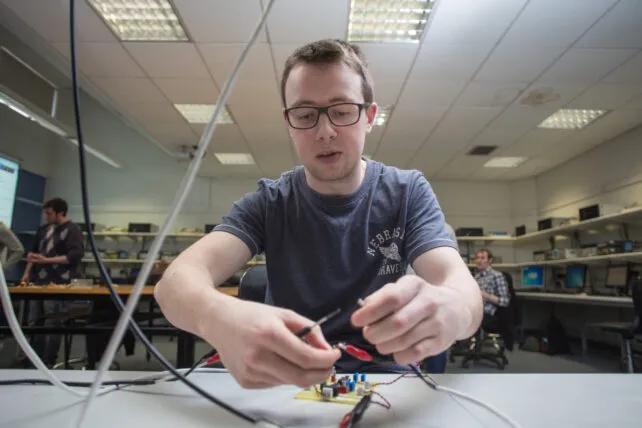
    The aim of this module is to introduce the learner to basic digital and analogue electronic concepts, components and circuits. The module will also aim to provide the learner with understanding of how to safely use laboratory equipment for building circuits and making measurements.

  • Engineering Professional Development 1

    Credits: 5

    To provide the learner with an opportunity to develop valuable transferable personal and professional skills. Utilising an active learning strategy, the learners will develop their knowledge and skills in a range of areas such as professional engineering standards and ethics, project management, problem solving, team working and communications. The student will apply these skills to a series of mini projects.

  • Electrical Workshop 1

    Credits: 5

    To introduce learners to basic electrical wiring diagrams and hands-on experience of wiring lighting, sockets, fuse boards, heating control systems and motor control circuits and learn to fault find on these various electrical circuits.

  • Manufacturing Engineering

    Credits: 10

    The module introduces the learner to the basic skills required to be a manufacturing engineer. It is envisaged that the learners will have the capability to understand, analyse, design and/or select the machinery, tooling and processes necessary for the production of components. The practical element of this module will enable the learners to have the practical skills required to safely operate workshop equipment to produce component to a desired specification. Upon, completion of this module the learners will have obtained the basic necessary skills to work safely in a manufacturing engineering environment.

  • C Programming 1

    Credits: 5

    This module introduces the learner to the C programming language to provide hardware and software solutions to technical based problems.

  • PLC Programming 1

    Credits: 5

    To provide the learner with the basic concepts of industrial control systems. It develops the knowledge and skills required to integrate discrete I/O with a programmable logic controller (PLC).

  • Process Control (Semester 1)

    Credits: 5

    To provide learners with the knowledge of process control which includes the basic concepts and fundamentals of PID systems.

  • Electro-Pneumatics (Semester 1)

    Credits: 5

    To provide learners with a knowledge of electro-pneumatic networks controlled using a PLC. To develop the learner’s ability to design, build, test and fault-find electro-pneumatic circuitry and control pneumatic networks and to be able to write, test and fault-find PLC programs to control various electro-pneumatic control sequences.

  • Process Calibration (Semester 2)

    Credits: 5

    To provide learners with the knowledge of industrial process instrumentation, calibration and control which includes the concepts, engineering and installation of control and measurement equipment.

  • PLC Programming 2 (Semester 2)

    Credits: 5

    This module is designed to introduce students to the concepts of Industrial Automation control systems in a range of applications and there by develop an understanding and application of the concepts. PLC programming will be used to apply the concepts.

  • Electrical Mechanical And Instrumentation Drawing (Year long)

    Credits: 5

    The aim of this module is to provide the learner with the knowledge to understand and design Electrical, Mechanical, and Instrumentation drawings.

  • Electrical Technology 2 (Year long)

    Credits: 5

    To build on the material covered in Electrical Technology 1, including 3-phase systems, with greater emphasis on applications; this will include transformers, motors and generation.

  • Engineering Professional Development 2 (Year long)

    Credits: 5

    To provide the learner with an opportunity to develop valuable transferable personal and professional engineering skills. Utilising an active learning strategy, the learners will build their employability skills in a range of areas starting with developing a Personal Development Plan (PDP), followed by learning a series of project management tools and techniques with a heavy emphasis on team working and collaborative working. The student will apply the skills learned in a group project that has a direct link to at least one other module in their degree programme.

  • Electrical Workshop 2 (Year long)

    Credits: 5

    The aim of this module is to provide the learner with a further understanding of electrical industrial wiring and the wiring and fault finding of Motor control circuits and electrical motors.

  • Industrial Electronics 2 And C Programming 2

    Credits: 10

    The aim of this module is to develop the learner’s knowledge of Analog and Digital electronic circuits that are specifically relevant to the Automation industry and specifically for data acquisition circuits. The module also introduces C programming language concepts to the learner.

  • Engineering Mathematics 2 (Year long)

    Credis: 10

    The aim of this module is to provide the learner with broad competencies in engineering mathematics and statistics. At the end of this module the learner will be able to use differentiation, integration, differential equations, linear algebra, descriptive statistics, probability theory and reliability analysis to model, analyse and solve engineering problems.

  • Modern Engineering Mathematics

    Credits: 5

    To provide the learner with the necessary mathematical background to model, analyse and solve problems in engineering.

  • Cisco Ip Networking

    Credits: 5

    This module will give the learner an introduction to Cisco IP networking providing the knowledge and skills required to build and configure a small network and examine its principle technologies and standards.

  • Applied C Programming

    Credits: 10

    This module is aimed at teaching the learner the C programming language using an applied approach by writing C programs deployed on a microcontroller. The C programs will be used to control external peripherals to the microcontroller, to solve Automation related problems, such as speed and position control of different motor types (e.g. DC / Stepper / Servo motors).

  • Motion Control And Robotics

    Manufacturing Automation: 10

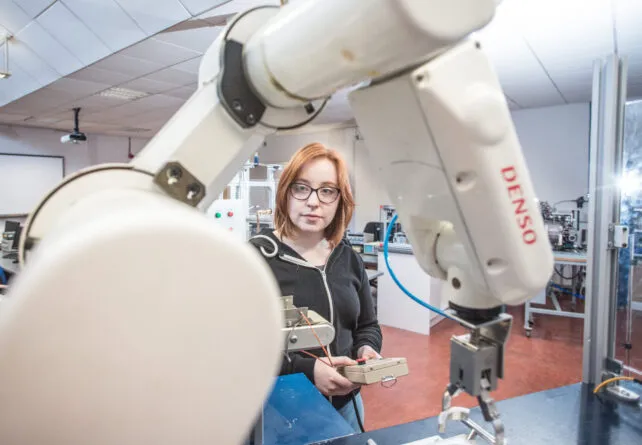
    To aim of this module is to develop the learners understanding of position and speed control for the various motors used in motion control and robotic systems. The learners will study the construction and operation of the various motor types aswell as the electronic drives used for controlling such motors. The learner will simulate and program a robot using appropriate software. The learner will also investigate faultfinding and throubleshooting strategies.

  • Work Placement

    Credits: 10

    This placement module will provide students with an opportunity to apply the theoretical and practical knowledge gained on their respective programmes while working in a professional engineering environment. It will also afford them the opportunity to gain valuable career experience and develop their understanding of working in such industry environments.

  • Advanced PLCs, HMI & SCADA

    Credits: 10

    To provide the learner with a specialised knowledge of advanced automation systems, structured programming approaches and distributed control applications. Also the learner will acquire the skills needed to successfully design, develop and integrate a SCADA solution.

  • Manufacturing Automation

    Credits: 10

    The aim of this module is to give the learner a thorough understanding of the elements of a control system relevant to the wiring, programming, handling, tracking and assembly of discrete products in a modern manufacturing environment.

What can you do after this programme?

Positions that graduates have worked in include:

  • Automation Technician
  • PLC and SCADA Programmer
  • Robotics Technician
  • Machine Build Technician
  • Equipment Maintenance Technician
  • Mechanical Design Technician
  • Electrical Design Technician
  • Process/Plant Technician

Successful graduates of this programme are eligible to progress to the Level 8 B.Eng in Robotics and Automation Engineering.

Course Videos

Additional Information

Similar Courses

TUS Limerick Electrical Engineering Students

Course Type: Undergraduate

Electrical Engineering – BEng (Hons)

Study Mode: Full Time

Level 8

Years 4

CAO points 348

Course Code US900

TUS Limerick Electronic Engineering with Computer Systems Student

Course Type: Undergraduate

Electronic Engineering with Computer Systems – BEng (Hons)

Study Mode: Full Time

Level 8

Years 4

CAO points 279

Course Code US903

TUS Limerick Renewable and Electrical Energy Engineering

Course Type: Undergraduate

Renewable and Electrical Energy Engineering – BEng (Hons)

Study Mode: Full Time

Level 8

Years 4

CAO points 336

Course Code US901

TUS Limerick Robotics and Automation Engineering Students

Course Type: Undergraduate

Robotics and Automation Engineering – BEng (Hons)

Study Mode: Full Time

Level 8

Years 4

CAO points 301

Course Code US902