

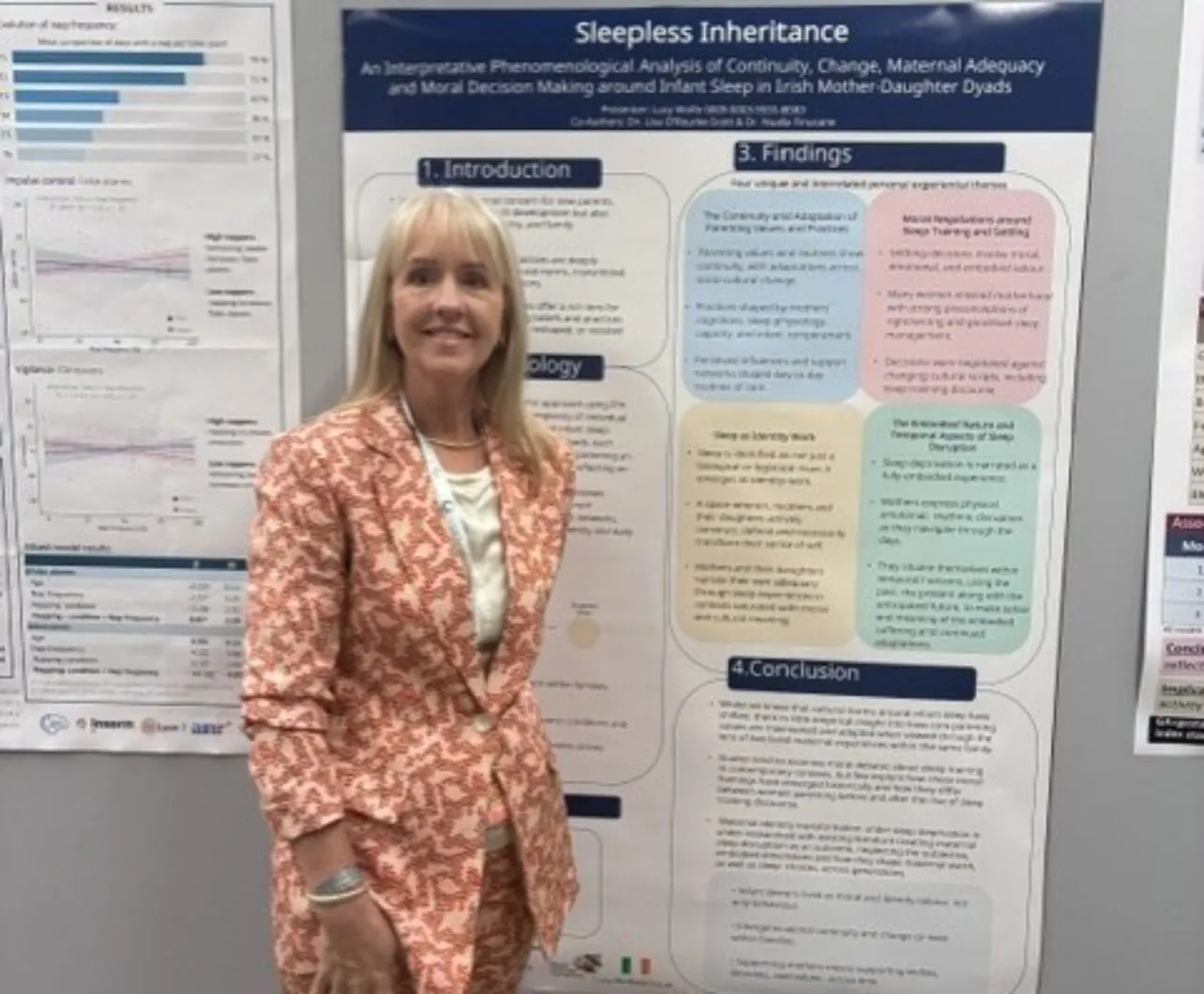
Infant sleep specialist and Technological University of the Shannon (TUS) researcher Lucy Wolfe has received international recognition for research examining how infant sleep shapes motherhood, wellbeing and family life across generations.
Ms Wolfe, a fourth-year PhD researcher with the Social Sciences ConneXions Research Institute at TUS, received a prestigious New Investigator Poster Award and €500 bursary at the 9th Annual Congress of the International Pediatric Sleep Association in Florence, Italy.
The award was presented to just four researchers from almost 250 poster presentations. Earlier this year, she also presented her research at the Museum of Motherhood Academic and Arts Conference in Florida. Supervised by Dr Lisa O’Rourke-Scott and Dr Nuala Finucane, Ms Wolfe’s doctoral research explores how beliefs, attitudes and choices surrounding infant sleep are passed between generations of mothers and daughters, and how these experiences influence wellbeing, identity and family relationships.
Drawing on interviews with mother-daughter pairs, the study found that while mothers and grandmothers often experienced many of the same challenges around infant sleep, settling and night-time care, the social and cultural context in which those experiences occur has changed dramatically.
Ms Wolfe said: “One of the first things that emerged was how strongly women are shaped by their own mothers. This wasn’t always in a simple ‘I did exactly what my mother did’. Sometimes daughters copied, sometimes they adapted and revised.”
The research identified four major themes: intergenerational continuity and adaptation, moral negotiations around sleep training and settling, sleep as identity work, and the embodied and temporal nature of sleep disruption.
One of the study’s most significant findings was the changing landscape of advice available to parents.
Ms Wolfe said: “For the older generation, knowledge often came from mothers, sisters, neighbours, friends, community, or a single trusted book. For the younger generation, there is still family advice, but now there is also Google, Instagram, TikTok, podcasts, sleep consultants, apps, baby trackers, online courses and WhatsApp groups.”
She added: “The contemporary mother is not lacking information, in fact perhaps there may be too much. As with more information often comes more comparison, more pressure and more doubt.”
Despite these differences, the study found that mothers across generations often shared remarkably similar values.
Ms Wolfe said: “One of the lovely complexities in the study is that the same underlying values often led to different practices. Across generations, mothers valued closeness, safety, rest, responsiveness and survival, but how those values were enacted varied hugely depending on the women, the baby and the unique family.”
The research also highlighted the wide range of approaches mothers use to help babies settle and sleep.
Ms Wolfe said: “The women described an astonishing range of strategies: rocking, feeding, shushing, patting, walking corridors, driving in cars, white noise, hoovers, music, routines, apps.”
The study found that infant sleep is rarely treated as a neutral issue, with many mothers describing feelings of judgement surrounding their choices.
Ms Wolfe said: “One of the most striking findings was how morally loaded the phrase ‘sleep training’ has become. For some mothers, it immediately meant ‘cry it out’. For others, it came to mean routine, support, structure, or gradual change.
“The study does not argue that there is one correct answer. Instead, it shows that mothers are often trying to find a morally sustainable middle ground and a way to protect the baby, protect the relationship and preserve themselves.”
The study also explored how sleep experiences shape maternal identity and self-perception.
“The imagined mother is organised, informed, calm, responsive, equal-partnered, but often when the baby arrives it is very different to what they envisaged, creating a rupture between the imagined self and the lived self.
“For many women, it is a profound identity transition under conditions of sleep deprivation, physical recovery, feeding demands, social comparison and constant responsibility.”
The research highlighted the profound impact of sleep disruption on women’s everyday lives, relationships and wellbeing.
Ms Wolfe said: “Sleep deprivation was not described as just feeling a bit tired. It was described as bodily, emotional, rhythmic disruption. The women described being sore, depleted, frustrated, out of control, unable to think clearly, unable to socialise, unable to exercise, unable to participate in normal life.
“Sleep deprivation traps women in repetitive time. The day is shaped by the night before.
The night is shaped by anxiety about the next day. The future becomes imagined through the hope that one day, somehow, the baby will sleep and life will widen again.”