Courses
Admissions & Support

Course Search
Courses
Admissions & Support
Course Search
Our Services
Our Community
Course Search
Governance
Professional Services

Location: Online
years: 2
A New Executive Master’s Programme Preparing Construction Leaders for the Future of Modern Methods of Construction.
Domestic and EU Applications Now Open.
Commencing in November 2026.
The construction industry is undergoing its most significant transformation in decades. Modern Methods of Construction are changing how projects are designed, manufactured and delivered. Organisations now need leaders capable of driving this transition.
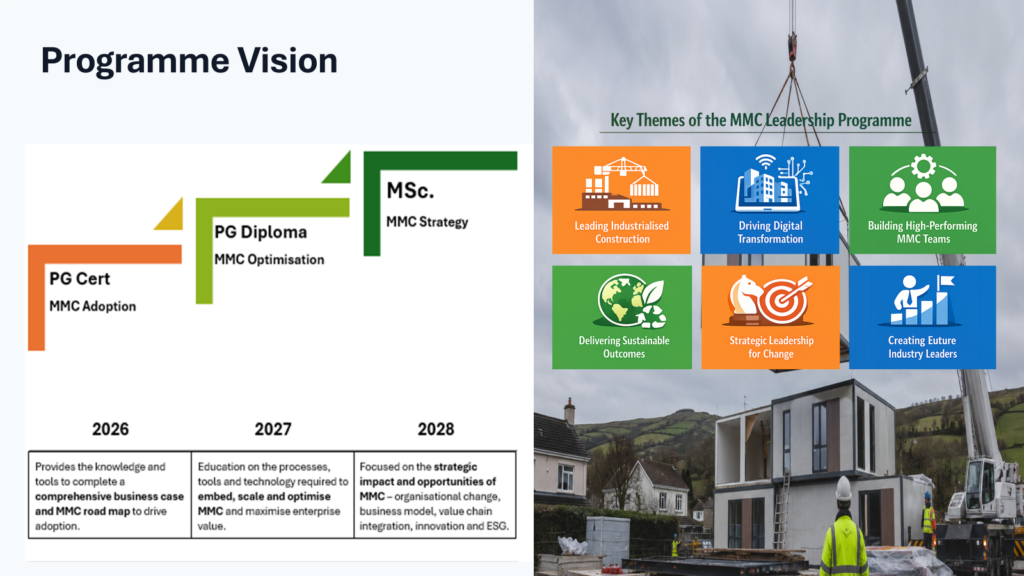
The MSc in MMC Leadership is an executive education programme designed to equip senior construction professionals with the capability to lead organisational transformation through the adoption, optimisation, and strategic implementation of Modern Methods of Construction (MMC). Delivered through three progressive stages, the programme enables leaders to improve productivity, reduce project risk, and deliver MMC successfully within their organisations.
The Postgraduate Certificate (30 ECTS) develops the foundations for MMC adoption, helping professionals identify opportunities, build compelling business cases, and develop practical strategies to implement modern construction approaches aligned with organisational goals.
The Postgraduate Diploma (60 ECTS) advances this capability by focusing on how organisations can optimise MMC delivery. Learners explore the processes, digital technologies, manufacturing approaches, and collaborative systems required to improve efficiency, integrate supply chains, and maximise value from MMC investment.
The MSc stage provides a strategic platform for leaders to drive wider business transformation. Through a focus on innovation, commercial strategy, organisational change, and future-focused delivery models, learners develop the capability to build competitive advantage and future-proof their organisations.
Together, the programme provides a flexible and progressive leadership journey, equipping senior professionals with the knowledge, confidence, and practical tools required to lead the next generation of construction delivery.
Applicants must meet one of the following entry pathways:
Applicants should hold a Level 8 honours degree in Construction, Engineering, or a closely related discipline. Entry to the programme will be guided towards applicants working within organisations that can actively support and facilitate workplace-based learning and application.
Applications are also welcomed from experienced mature candidates who do not hold a Level 8 qualification but can demonstrate relevant professional experience. Such applicants will be considered in accordance with the Technological University’s Recognition of Prior Learning (RPL) procedures.
For further information please contact:
Alan Duffy, Head of department of Built Environment and Trades
Email: alan.duffy@tus.ie
Technology & Ecosystem Exploration
Credits: 5
Gain a clear, practical introduction to Modern Methods of Construction (MMC) in Ireland. This module explores key technologies, industry players, certification, and regulation, giving senior leaders the insight needed to confidently assess opportunities and kick-start MMC adoption within their organisations.
(Also available as a standalone micro-credential)
Market & Strategic Intent Development
Credits: 5
Turn insight into strategy. This module equips senior leaders to analyse the MMC market, assess organisational readiness, and define a clear, evidence-based vision for adoption. Using proven strategic frameworks and real industry insights, participants will build the confidence to lead MMC decisions and drive organisation-wide change.
(Also available as a standalone micro-credential)
Supply Chain, Contractual & ESG Considerations
Credits: 5
Deliver MMC with confidence. This module equips senior leaders to manage the contractual, procurement, certification, and operational realities of off-site delivery. From risk allocation and supply chain coordination to compliance and ESG performance, participants gain the practical insight needed to successfully deliver MMC projects at scale.
(Also available as a standalone micro-credential)
Financial Feasibility & Business Case
Credits: 5
Make smarter investment decisions. This module builds the financial insight needed to evaluate MMC opportunities, compare them with traditional approaches, and understand their full commercial impact. Participants learn to analyse costs, test assumptions, and present clear, compelling business cases that support confident, evidence-based decision-making.
(Also available as a standalone micro-credential)
Pilot Delivery & Adoption Roadmap Capstone
Credits: 10
Put strategy into action. This capstone module enables participants to apply their learning to a real MMC adoption challenge within their organisation. Through the development of a pilot project plan and strategic adoption roadmap, learners integrate technical, commercial, operational, and leadership perspectives to confidently progress MMC transformation.
BIM and Digital Design Optimisation
Credits: 5
Unlock the power of digital delivery for MMC. This module develops the skills to lead BIM-enabled design optimisation, connecting digital models with manufacturing, logistics, and on-site assembly. Participants explore DfMA, standardisation, and digital workflows to create efficient, repeatable, and scalable MMC solutions.
(Also available as a standalone micro-credential)
Automation & Process Optimisation
Credits: 5
Drive productivity through technology and innovation. This module equips senior leaders to evaluate and implement AI, automation, and lean approaches within MMC delivery. Participants explore emerging digital capabilities, performance optimisation, and investment considerations to lead the transition towards smarter, more efficient, manufacturing-led construction.
(Also available as a standalone micro-credential)
Supply Chain Optimisation
Credits: 5
Build resilient, high-performing MMC supply chains. This module develops the capability to design, manage, and optimise the connected systems that bring factory, logistics, and site delivery together. Participants explore supply chain strategy, lean operations, performance management, and risk resilience to maximise MMC value and delivery performance.
(Also available as a standalone micro-credential)
Organisational Design & Capability Optimisation
Credits: 5
Lead the organisational change behind MMC transformation. This module equips senior leaders with the tools to build the capabilities, structures, and culture required to scale MMC successfully. Participants explore workforce development, governance, performance management, and change leadership to create organisations ready for manufacturing-led construction.
(Also available as a standalone micro-credential)
Business Development & Strategic Growth Capstone
Credits: 10
Transform MMC capability into strategic growth. This capstone module enables leaders to translate operational improvements, digital capability, supply chain strength, and organisational readiness into commercial advantage. Participants develop a strategic growth plan, building the business case for scaling MMC and positioning their organisation for long-term success.
Business Development & Strategic Growth Capstone
Credits: 30
Lead transformational change at scale. This final MSc capstone module challenges participants to apply their expertise to a complex, industry-focused MMC transformation project. Combining strategic analysis, applied research, innovation, and leadership, learners develop evidence-based solutions that address enterprise, sector, or system-level challenges and demonstrate the capability to deliver lasting change.
Graduates of this programme may progress to further Level 9 and Level 10 awards in cognate areas, including construction management and related disciplines, in line with the National Framework of Qualifications (NFQ) and the University’s established progression pathways.
Opportunities may include further postgraduate study or research with the research faculty at Technological University of the Shannon (TUS), Midlands Campus, Athlone. Progression opportunities, including any applicable exemptions or recognition of prior learning, will be considered on a case-by-case basis in accordance with the University’s approved RPL and progression policies, and subject to the entry requirements of the receiving programme.
Graduates will be equipped to lead the adoption and optimisation of Modern Methods of Construction across the built environment sector. They will progress into senior roles within construction, development, MMC manufacturing, consultancy, and public-sector organisations, driving innovation, improving productivity, reducing risk, and delivering sustainable transformation across projects and organisations.
For additional guidance and support, please click on the options below: