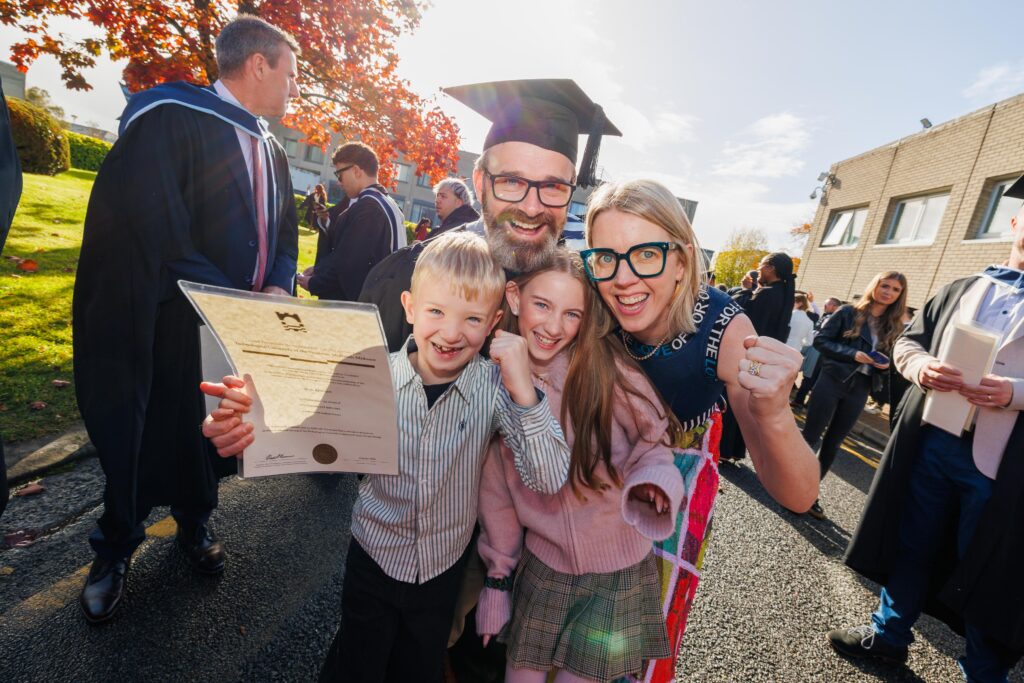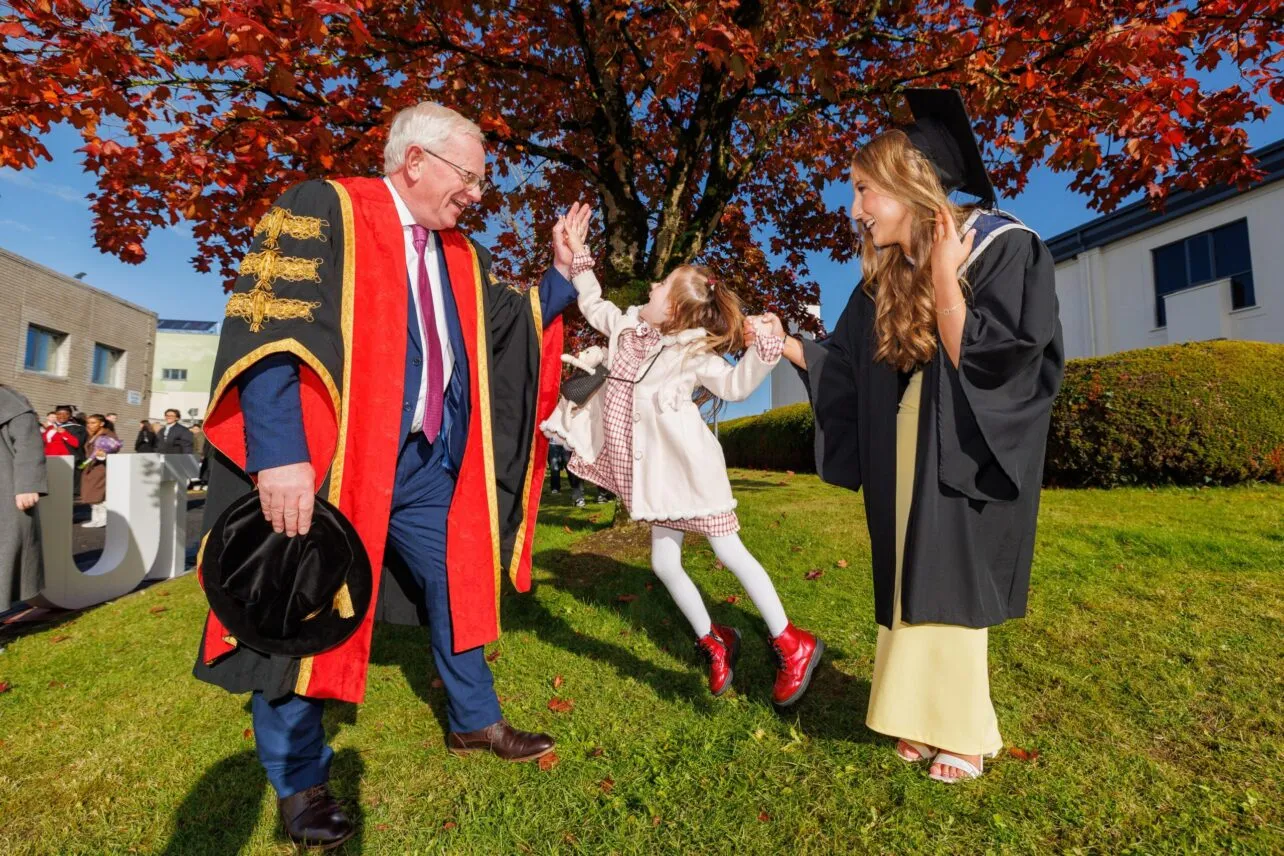
The rapid rise of Artificial Intelligence will make human judgement and critical thinking increasingly valuable, TUS President Professor Vincent Cunnane has told more than 3,100 graduates.
Speaking at his final graduation ceremonies as President of Technological University of the Shannon (TUS), Professor Cunnane reflected on the extraordinary transformation in AI during the relatively short period in which many of the Class of 2026 have been at university.
Professor Cunnane, the founding President of TUS, will retire at the end of January after leading the university since its establishment in 2021.
He will be succeeded by Professor Paul Connolly, who will take up the role in spring 2027.
A total of 3,109 students are graduating from TUS: 1,331 at ceremonies in Athlone on Tuesday and Wednesday, October 27 and 28, and 1,778 at the Moylish Campus in Limerick on Thursday and Friday, October 29 and 30.
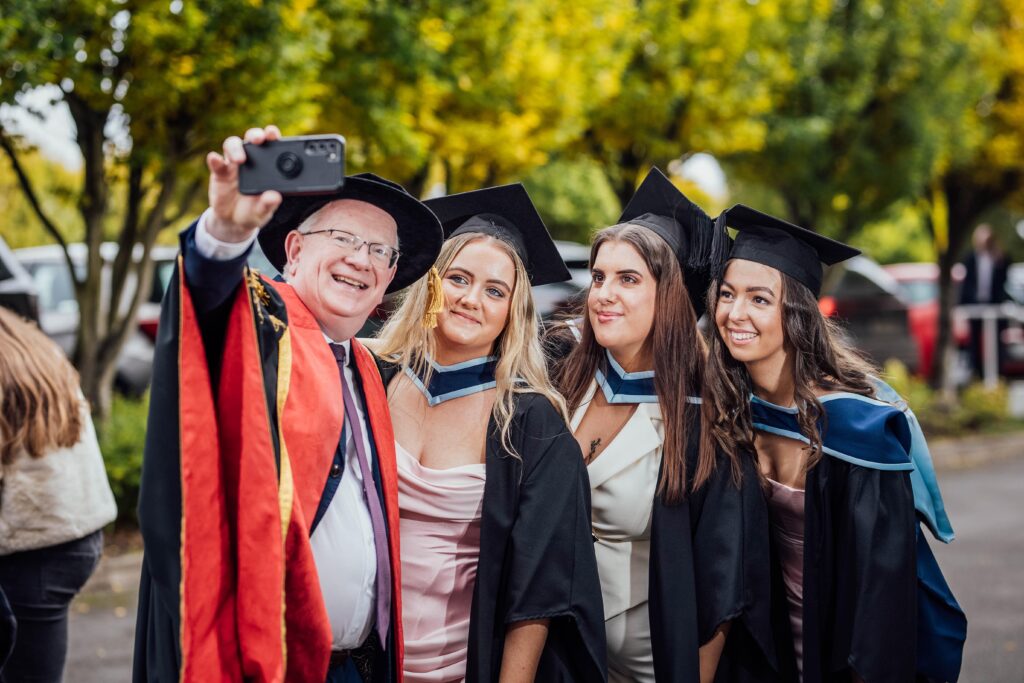
Addressing the graduates, Professor Cunnane said:
“When TUS was launched in October 2021, very few people outside of a research lab had ever had a conversation with an artificial intelligence. Just over a year later, at the end of November 2022, ChatGPT was released to the public. Many of you sitting here today had started college only ten weeks before.
“Think about that – you began your degree in one world, and you are finishing it in another.”
Professor Cunnane said AI had gone from a curiosity to technology capable of writing, coding, designing and analysing, with its future impact on work and learning impossible to predict. But he told graduates that the increasing capabilities of AI would place an even greater premium on human judgement.
“The more capable these tools become, the more valuable human judgement becomes – and that is good news for every one of you.
“A machine can produce a report, a diagnosis or a design in seconds. But it can’t stand over it. Behind every good decision there will always be people who weigh it up and who answer for it.
“A machine can give you an answer, and a very convincing one. But it can’t tell whether the question was the right one, whether the answer is true, or what it has left out. When words and images can be produced without limit, knowing what to trust becomes a rare and precious skill.”
Against that backdrop, Professor Cunnane urged graduates to hold on to three things that he said “do not go out of date”: knowledge, critical thinking and values.
“Information is everywhere now, and it is cheap. Knowledge is completely different. Knowledge is what tells you when something is wrong, and more importantly, it is what shows you how to put it right.”
On critical thinking, he added: “The habit of asking: how do we know this? What is the evidence? Who benefits from my believing it? In a world of instant answers, the person who can still ask a good question is worth their weight in gold.”

Professor Cunnane said technological upheaval was not the only profound change the Class of 2026 would experience, pointing to the scale of projected climate change over the remainder of this century.
“At the height of the last Ice Age, some twenty thousand years ago, when much of Ireland lay under a kilometre-deep sheet of ice, the world was only three or four degrees colder than it is today.
“On the path we are currently on, the United Nations projects that the world will warm by close to three degrees by the end of this century. That is a change on the same scale as the one that ended the Ice Age – but in the opposite direction, and in the space of a single lifetime rather than hundreds of generations.
“Many of you will see the year 2100 for yourselves. The end of this century is not an abstraction for you – it is a date in the diary. So this is not someone else’s future. This is your reality.”
Backing the graduates to face the challenges ahead, Professor Cunnane said:
“I don’t tell you this as a warning, it’s a vote of confidence. Because I know who you are.
“Many of you finished secondary school in the shadow of a pandemic – with lockdowns, closed classrooms and exams that nobody was quite sure would happen. You came into college when the world was still finding its feet. And you made it. You are here today.
“That is resilience, and it is not something you read about in a textbook. You have lived it.”
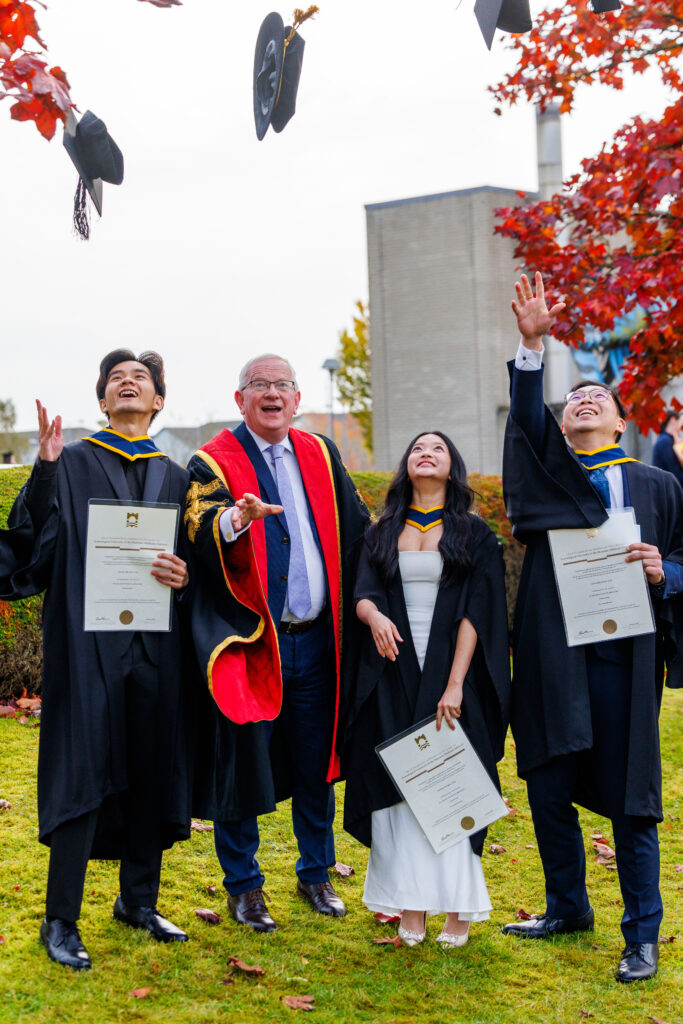
Josephine Feehily, who has chaired the TUS Governing Body since the university was established in 2021, also addressed graduates during what will be her final conferring week as Chair.
Echoing Professor Cunnane’s emphasis on the importance of values, Ms Feehily reflected on the six adopted by TUS – inclusive, supportive, ambitious, innovative, sustainable and collaborative – which she said had never been intended simply as “words on a page”.
“As you head out into a world that is changing at an extraordinary pace, I hope those values will be your anchors. When the ground shifts under you, values are what keep you steady.
“You will need them for a long time. Your generation is likely to live longer, and work longer, than any before it. You may have several careers, not one. The jobs that some of you will hold in twenty years’ time have not even been invented yet.
“That might sound daunting. I would say it is also liberating. It means today is not the end of your education – it is only the end of the beginning.”
This year’s conferrings represent the closing of a chapter for two figures who have held key leadership roles at the university since its establishment.
Paying tribute to Professor Cunnane, Ms Feehily said he had taken TUS “from an idea to a university”, steering it through the Covid-19 pandemic, the bringing together of two institutions and the growing pains of establishing a new university.
“What I will remember most is not the strategy, or the buildings, or the board papers. It is the way he knows the people in every function and on every campus by name. The way he stops to listen. The way he cares – genuinely cares – about students like you, and about the places you come from,” she said.
Professor Cunnane also paid tribute to Ms Feehily and her contribution during the university’s formative years.
“Over a long career of public service – including as Chair of the Revenue Commissioners and as the first Chair of the Policing Authority – Josephine has made something of a habit of being first. TUS has been fortunate to have both of those gifts from its very first day: her rigour, her wisdom, her steadiness and her wit.”
Professor Cunnane also highlighted the employment success of TUS graduates, noting that for the third consecutive year they have recorded the highest graduate employment rate of any university in Ireland.
In his final message to the Class of 2026, Professor Cunnane urged graduates to approach the changes ahead with confidence and hope.
“Five years ago, this university was a promise. Looking out at you today, I can see that promise kept.
“You are graduating into a world that is changing at a remarkable pace. Carry with you your knowledge, your critical thinking and your values. And above all, carry hope – not as a feeling, but as a way of acting.”