

Course Search

Course Search

Course Search

Automation and Robotics – BEng (Hons)

  • CAO Points: 251

  • Location: Athlone

  • years: 4


Course Overview

Robotic and automation solutions are revolutionising sectors such as manufacturing, healthcare, and transport. This course is designed to equip learners with the specialist knowledge and wide range of hands-on practical skills at the cutting edge of instrumentation, robotics, process control and industrial automation to pursue a career in this dynamic and evolving field. Engineers with skills in this area are now in very high demand in the manufacturing sector. Many companies are struggling to fill their required positions due to a shortage of graduates. As more and more companies adopt robotics and automation the requirement for engineers in this area is set to increase.

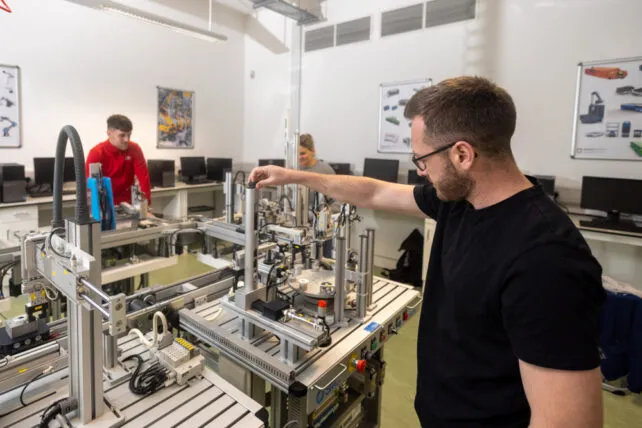
If you are a motivated person with a creative mind, and are interested in engineering and how things work, then Robotics & Automation could be for you. TUS Midlands has strong ties with industrial partners to ensure students get to experience cutting edge technology. Software such as RoboDK is utilised to design and simulate robot cells which can be replicated on one of our industrial robots, providing hands on experience for students.

Industrial work placement is embedded in the course in year three. The student is required to complete a six-month placement from January to June in the third year of the course. The placement carries 25 credits and must fulfil prescribed criteria to which the employer will agree in advance. Graduates are encouraged to secure positions regionally, nationally or internationally in automation and manufacturing roles. This is supported by a dedicated placement officer within the college leveraging our strong industrial partnerships.

Contact Details

Cian Bregazzi-Nevin

Email: Cian.BregazziNevin@tus.ie

What are the entry requirements?

Leaving Certificate

Grade H5 at higher level in two subjects, plus Grade O6/H7 in four other subjects in the Leaving Certificate. Two of these subjects must be mathematics and a language (English or Irish).

QQI

QQI applicants to this programme must hold the following award: engineering technology (5M2061). They are also required to have the module mathematics (5N1833) or Maths for STEM (5N0556) included in their award or alternatively have Leaving Certificate mathematics. They must also possess distinctions in three modules.

Further Education/Prior Learning Applicants

Applications will also be considered for Direct/Advanced Entry from those with a FETAC Level 5/6 qualification (or equivalent) and/or relevant prior learning. Click here to learn more.

Mature Applicants

Candidates appling as mature applicats (23 years of age on 1st January prior to admission) must apply through the Central Applications Office (CAO). As a mature applicant, you have the opportunity to provide additional information about yourself which may help with your application. You can provide details on your employment history, your hobbies and interets, any voluntary work you have done etc.

International Applicants

International applicants should apply directly to the International Office at TUS, allowing plenty of time for completing the visa process. Applications for September start should be made by 1st June at the latest to ensure visas are processed in time. You should familiarise yourself with visa processing times for your country of origin to ensure you make a timely application. Find out more here.


Course Modules

  • Communications for Manufacturing 1.1

    Credits: 5

    This course will develop students interpersonal skills, focusing on conversation, active listening and body language. It will also improve students knowledge of learning and help them develop the skills for lifelong learning.

  • Engineering Science 1

    Credits: 5

    This module introduces the candidates to the fundamental principles of physics in an engineering context. It contains theoretical, practical and empirical material

  • Mechanics 1.1

    Credits: 5

    This module will introduce to the student to the basic concepts of engineering mechanics related to simple engineering systems. It will broaden the student’s knowledge of the basic principles that are fundamental to mechanical engineering design and the operation of mechanical systems.

  • Engineering Materials 1.1

    Credits: 5

    A strong knowledge of engineering materials is essential for a manufacturing engineer when designing, manufacturing and analysing a product. The module is primarily concerned with the structure-processing-property relationship of engineering materials with an introduction to the four main categories of materials Polymers, Metals, Ceramics/Glasses, Composite.

  • Processing of Engineering Materials and Engineering Workshop and Graphics 1.1

    Credits: 5

    The overall aim of this module is to introduce students to drawing, machining and safety. The module provides the student with the skills needed to draw, read and interpret engineering drawings. The students are introduced to CAD software to produce drawing templates. The module provides the student with the skills and knowledge of current standards in engineering drafting practice in both manual and computer aided drawing. The workshop component develops safety skills, safety awareness, machine tool milling and turning skills and assembly of engineering components. Teaching strategies are employed to develop the students’ ability to problem-solve and participate in self-directed and collaborative learning.

  • Mathematics

    Credits: 5

    This course gives students a foundation in the mathematics required for the study of Mechanical Engineering, Polymer Engineering and Automation & Robotics.

  • Communications for Manufacturing 1.2

    Credits: 5

    This course will continue to develop students skills in communication, focusing on presentation skills both with and without notes, academic writing styles and structures. Students will carry out extensive work with Excel, to include creating and manipulating formulae and graphs. They will also learn to apply basic statistics to excel.

  • Electronics Technology 1

    Credits: 5

    This module is an introduction to electronics. The theory of electronics will be taught by way of lectures. The lectures will be supported by lab- based activities. Students will acquire skills to identify components, perform calculations, build and test simple circuits. This module will be of benefit to future electronics and electromechanical studies.

  • Mechanics 1.2

    Credits: 5

    The module will expand the students’ knowledge of solid mechanics with work on friction, simple machines, work power energy, linear and angular motion. It will broaden the student’s knowledge of the basic principles that are fundamental to mechanical engineering design and the operation of mechanical systems.

  • Processing of Engineering Materials 1

    Credits: 5

    The aim of this module is to introduce students to modern engineering processes. The processing of polymers, metals, ceramics and glasses will be covered. Students will get hands-on experience using a range of polymer processing equipment.

  • Engineering Workshop and Graphics 1.2

    Credits: 5

    In this module students experience hands on safe mechanical workshop practices. The importance of safety within a workshop environment. A knowledge of machine tools associated with workshop practices. The module provides students with the skills and the knowledge of current standards in engineering draughting practice in computer-aided design. Students ability to problem solve and participate in self-directed and collaborative learning are central to this module.

  • Mathematics 1.2

    Credits: 5

    This course gives students a foundation in the mathematics required for the study of Mechanical Engineering, Polymer Engineering and Automation & Robotics.

  • Sensor Systems 2

    Credits: 5

    This module introduces the learner to various sensors that may be applied in a range of process control, automated and robotic systems.

  • Mechanics 2.1

    Credits: 5

    This module concentrates on that branch of Engineering Mechanics known as ‘Statics’. Statics is the branch of Mechanics that is concerned with the analysis of loads (force and torque, or “moment”) on physical systems in static equilibrium, that is, in a state where the relative positions of subsystems do not vary over time, or where components and structures are at a constant velocity.

  • Mathematics 2.1

    Credits: 5

    To provide the student with a deeper understanding of mathematical methods as applied to Mechanical and Polymer Engineering problems and give them the necessary mathematical background to understand concepts introduced in other subjects.

  • Computer Aided Design 2

    Credits: 5

    To provide the student with the knowledge of more advanced 2D and 3D Cad techniques to enable the student to create parts, assemblies and fully dimensioned orthographic drawings. To provide the student with the knowledge to run a simple static finite element analysis simulation.

  • Electronics Technology 2

    Credits: 5

    Introduction to the theory of op-amps, 555 timer, oscillators and transistors. Labs used to support lectures.

  • Engineering Economics 2

    Credits: 5

    To help students interpret simple financial statements used by companies to reflect performance. To provide the student with the tools to appraise simple projects in terms of cost and benefit. To appreciate the importance of cost reduction. To make students aware of ethical issues associated with financial management.

  • Control and Power Technology 2

    Credits: 5

    This module introduces the concept of a control system and its various elements, and examines system behaviour. In this context it introduces pneumatics as power sources and its applications. It also introduces the student to the programmable controller by way of simple examples and programs. The module provides the student with an understanding and knowledge of the theory of electrical circuits covering both a.c. and d.c. industrial installations.

  • Mechanics 2.2

    Credits: 5

    This module builds on the basic concepts of mechanics of machines. The material covered in the module examines the response of bodies or systems of bodies to external forces.

  • Mathematics 2.2

    Credits: 5

    To provide the student with a deeper understanding of mathematical methods as applied to Mechanical and Polymer engineering problems and give them the necessary mathematical background to understand concepts introduced in other subjects.

  • Electrical Technology 2

    Credits: 5

    This module will introduce the student to components of the electrical infrastructure typical of the industrial environment including transformers and motors.

  • Introduction to Robotics 2

    Credits: 5

    This module introduces learners to key concepts in the robotic domain: electronics, mechanics, and software necessary to control a robotic device. Learners will program intermediary systems to interface between real world transducers and a human interface. Learning will take place in a largely practical environment, with a hands-on approach. Students will build and program some robotic equipment (e.g. Arduino Braccio robot arm) and will be introduced to generic robotic programming languages (e.g. RoboDK, ROBOTC programming language and ROS (Robotic Operating System)).

  • Automation Practice 2

    Credits: 5

    The intent of this module is that students develop their knowledge of automation systems through practical examples and practical work. Students will produce mechanical component/assemblies in the mechanical engineering workshop. They will produce technical documentation on the practical work undertaken. Students will create schematic drawings and simulate electronic circuits using a microcontroller to control outputs like motors. They will solder a PCB and develop the skills to fault-find and debug problems. Emphasis on developing the students problem-solving skills and self-directed learning ability by means of project-based learning is a large part of the teaching the strategy employed.

  • Statistics and Lean Sigma 3

    Credits: 5

    This module provides Engineering Students with statistical tools required for evaluating process performance with the intention of making improvements and maintaining control.

  • Mathematics 3

    Credits: 5

    This module is designed to introduce students to problem-solving using Laplace transforms, linear programming, matrices and statistics

  • Robotics Prgramming & Vision 3

    Credits: 5

    This module will build on the knowledge developed in Introduction to Robotics (TECH6006) and introduce vision and manufacturer specific programming environments. The student will continue the use of an appropriate software package (e.g. RoboDK) to program and control a complete robotic system through simulation and practical tasks. This may be completed using a scale model robot or full size industrial unit with various end tooling. Students will also be introduced to manufacturer specific languages and programming environments (e.g. Polyscope, RoboStudio, MELFA, and KAREL). A foundation in robotic kinematics for movement of joints and tooling will be developed.The use of computer vision systems within an automation environment will be introduced. Commercial vision solutions (e.g. PickIT and Cognex) will be compared and investigated, and simple vision elements integrated into robotic systems. The fundamentals of vision for part picking, quality assurance and robotic guidance will be explored.

  • Control & Mechatronics Systems 3

    Credits: 10

    This module has two main aims. It aims to promote a basic understanding of control theory and robot kinematics while building on the students existing knowledge of programmable controllers in dealing with sequencing control tasks. It aims to develop the students” ability to construct, program and commission modular mechatronic production systems and to develop work methods in keeping with modern mechatronics professional practice. A large element of practical work will be used in this module to provide the students with hands-on experience.

  • Computer Networks 3

    Credits: 5

    To provide the student with the fundamentals of computer networking.

  • Project Evaluation and Management 3

    Credits: 5

    The module will enable students to critically evaluate project proposals as well as plan and manage their own projects and participate in industrial projects.

  • Industrial Placement 3

    Credits: 25

    Industrial Placement forms an integral part of the degree programme. Learners must complete the requisite industrial experience with a suitable commercial body for a minimum period of 24 weeks. A student may extend this period by mutual agreement with the company/host. Throughout this period learners will work on the preparation of an evidenced backed portfolio. On completion of this work experience learners will be assessed by a number of methods including reports, presentations, poster presentations and interviews.

  • Regulatory Compliance and Validation 4

    Credits: 5

    Pharmaceutical and Medical Devices industries must comply with the regulatory requirements of the markets that they supply to. This module aims to equip students with the requisite knowledge that will allow them to adhere to the specific regulatory requirements of safety, efficacy, quality and performance.
    Validation is a regulatory requirement as well as a process of establishing documentary evidence demonstrating that a procedure, process, or activity carried out in testing or production maintains the desired level of compliance. This module will incorporate the documentary and testing requirements of a validation programme.

  • Computer Aided Engineering Design & Analysis 4

    Credits: 5

    The successful alignment and integrated implementation of all analytical and computational techniques resulting in a more streamlined engineering design/manufacturing process with reduced costs, decreased development time and improved quality through the efficient usage and application of computational engines and appropriate industry-specific software.

  • Electrical Power Systems and Machines 4

    Credits: 5

    This module will introduce the student to components of the electrical infrastructure typical of the industrial environment.

  • Final Year Project (Year long)

    Credits: 10

    To develop the student’s ability to carry out independent research into a relevant topic of technical merit related to the particular field of study.
    To demonstrate the student’s ability to draw together in-depth knowledge and skills gained throughout the programme of study, together with independent learning, and to apply to a current and relevant industrial based engineering project.
    To instil in the student the techniques required for effective dissertation preparation and presentation at an industrial level.

  • Robotic Vision & Interaction 4

    Credits: 5

    For this module image capture and analysis techniques will be examined and compared. Industry leading software will be utilised to develop an advanced vision integrated robotic manufacturing process. This will be explored through the use of simulation software and physical systems. Real-Time simulation and 3D rendering is regularly utilised during the offline programming of robotic systems. This allows for the interaction between robots and other manufacturing equipment to be assessed. Software packages such as Solidworks and RoboDK can be used in conjunction with 3D rendering engine to create virtual simulation environments which allow for rapid prototyping and interaction with proposed robotic systems. The integration of virtual reality (VR) and augmented reality (AR) in the modern manufacturing environment will be explored, and its suitable uses discussed. This module will build on the foundation theory from Robotic Programming and Vision (AUTO07001).

  • Enterprise Networks 4

    Credits: 5

    Network technology is facilitating a dramatic increase in connectivity between people, people and machines and machine to machine. This module focuses on four key topics; Enterprise Networks, Routing Protocols, Wireless Networks and Sensor Networks. These are all key networking skills which can be applied in a variety of engineering systems including robotics and autonomous vehicles.

  • Operations Management & Sustainability 4

    Credits: 5

    This module addresses two important areas of management that are essential to an engineering graduate; operations and sustainability. Operations management as a concept is introduced by exploring the role that operations management plays in productivity as well as global operating environments and strategy. Key aspects of designing operations are explored such as product design & development decisions in particular design for sustainability and product safety, process design, layout decisions, job design, ergonomics, and workplace safety. Sustainability at the level of the organisation is explored with particular emphasis on the sustainability of the transformation process.

  • Industrial Control 4

    Credits: 5

    The aim of this module is to enable the learner to acquire a good knowledge of industrial process control systems theory and practice, including PID control and loop tuning.

  • Manufacturing Automation 4

    Credits: 5

    The aim of this module is to enable the learner to apply suitable manufacturing automation strategies and technology in an industrial context and provide the learner with hands-on experience of these systems.

  • Robotic Programming Motion & Tooling 4

    Credits: 5

    Robot manufactures have each developed their own propriety software for controlling their devices. As different as each of these languages are they all rely on the same fundamental kinematics to achieve smooth motion and control. These kinematic equations of motion will be presented and analysed for various multi axis systems to understand how motion is achieved through programming. Tool path plotting and positioning is a critically important element of any robot program. Manufactures have developed off the shelf solutions for common tasks such as welding or painting which simplify the programming of these tasks. These add-on tools within software (e.g. RoboDK) will be explored and their underlying code examined. Manufactures also allow for custom scripts, in common programming languages (e.g. Python) to be executed as part of complete robot programs. Tool choice can be difficult due to the variety of options from a multitude of manufacturers. This module will examine current frequently deployed tool types and the state-of-the-art offerings. This module will build on the foundation theory of Robotics Programming & Vision (AUTO07001).

  • Connected Devices 4

    Credits: 5

    The aim of this module is to understand the need for an end to end system solution from human interface (mobile app/web) to a connected device, and the engineering process to design, implement and validate them. The module will have a particular focus on the actions required for enhanced end user interaction and deployment of such solutions. This module develops learning in the area of connecting traditionally non-networked devices to a network. Learners will develop intermediary systems to interface between real world transducers and a web-based interface. This module will allow a user to access the capabilities of Internet of Things connected devices through their varied devices (mobile/web based).

What can you do after this programme?

Your specialised knowledge of automation and robotics can lead to direct employment in the manufacturing industry.

Graduates will find employment in the manufacturing sector generally, across a broad range of industries, such as the medical device, electronics, agricultural and pharmaceutical sectors. Typical jobs include automation engineering, process development, fault-finding, as well as working in multi-disciplinary teams in a modern manufacturing environment.

Successful graduates of this programme are eligible for Level 9 and 10 postgraduate programmes within TUS or elsewhere.

Additional Information

Similar Courses

TUS Athlone Automation and Robotics Students

Course Type: Undergraduate

Automation and Robotics – BEng

Study Mode: Full Time

Level 7

Years 2

WindTunnel1Group

Course Type: Undergraduate

Engineering (Common Entry) – BEng

Study Mode: Full Time

Level 7

Years 3

CAO points 223

Course Code US773

Mechanical_Engineering_Degree_Ireland_1000_667

Course Type: Undergraduate

Mechanical Engineering – BEng (Hons) (Athlone)

Study Mode: Full Time

Level 8

Years 4

CAO points 278

Course Code US910

4

Course Type: Undergraduate

Mechanical Engineering with Energy – BEng (Hons)

Study Mode: Full Time

Level 8

Years 4

CAO points 308

Course Code US912

Polymer and Mechanical Engineering

Course Type: Undergraduate

Polymer & Mechanical Engineering – BEng (Hons)

Study Mode: Full Time

Level 8

Years 4

CAO points 302

Course Code US913

TUS Athlone Design Engineering Students

Course Type: Undergraduate

Design Engineering – BTech (Hons)

Study Mode: Full Time

Level 8

Years 4

CAO points 319

Course Code US812